Saturday, June 11, 2011

A break from those crazy loggers!

It's been a while since I've posted once again, sorry! 
I think I'm going to take a break from the logging chats and talk about something cool that has been taking place the last couple weeks.  As I was out along the St Croix River last weekend I happened to look up in several locations to see hundreds and hundreds of dragonflies flying around!  "Yeah, so what Katie," you might say, "what's so great about dragonflies?"  Well, I'm glad you asked! 
I love dragonflies for a multitude of reasons.  The number one reason however is the fact that they eat many hundreds of biting insects a day! 
Another reason these critters are so cool is their phenominal life cycle!  Dragonflies start their lives out much like most other aquatic insects, as an egg.  When you see a dragonfly flying above the water and occasionally tapping her abdomen into the water, she's actually laying her eggs.  Some species will actually insert their eggs into the stem of an aquatic plant!  (Some people say they've been bitten by a dragonfly but odds are it was just the female mistaking them for an aquatic plant.)
Anyway!  They start out as a mass of eggs, that look something like this:
These eggs can live in this stage for a range of times depending on when they were layed and what species they are.  Some will last only a few days as eggs where others will make it through the winter in this stage.  
Once they hatch out they become a water insect that's called a dragonfly nymph or larvae.  Again, with there being so many different species of dragonflies, there are a lot of different sizes and shapes of these water bugs.  Here's  a great picture of a dragonfly nymph:
As you can see these guys are pretty fierce looking, almost like a dinosaur.  It's pretty fitting too since they are like a living dinosaur!  We'll talk about that later though!
So when they're in their nymph stage dragonflies are pretty spectacular.  They are great predators and will eat just about anything they can catch.  In fact, in an ecosystem where dragonflies are present, when they're in the nymph stage they're pretty much the top of the food chain!  They'll eat other aquatic bugs, tadpoles,  and even small fish if they can catch them.  WOW!!
Now something else that's pretty cool about these guys is that some species can live in this nymph stage for up to eight years!  EIGHT YEARS!!  They're pretty easy to catch when they're nymphs as well.  We like to take an aquarium net down to the river and tap it along the bottom of the river along the shore.  Without fail we always come up with one of these guys.  Just like humans, different speices of dragonflies like to live in different places.  Some prefer fast flowing water, some prefer slow moving water, and some just prefer to live in a lake or pond setting where the water isn't really moving much at all. 
If you do find one of these guys in the water take a good look at them.  If you're able to clearly see where his wings are going to be then you've found one that's almost ready to emerge! 
In the spring when both the air temperature and the water temperature start to warm the dragonflies start to emerge in large numbers. 
What will happen is when the time is right the dragonfly nymph will crawl out of the water and with his legs hill hold onto something. (Their legs are sticky kind of like a grasshopper's)  And they'll hold on to a log, a rock, a stick, a piece of grass, pretty much anything!  They'll  hang out there and start gulping in water. Gulp gulp gulp!  Until their back SPLITS right open, and then they'll pull themselves right out of the bug!!  A good way to think about it is like a caterpillar and it's cacoon. 
Crazy right!?!?!?
SO!  Remember how I said when they live in the water they're near the top of the food chain?  Well things change quickly once the emerge from the water!  If you've ever been swimming too long you know that your skin gets kinda pruny and wrinkley right?  Well imagine these guys that have lived in the water for a few  years!  Their bodies are soft and they need to hang out and let their bodies, legs, and wings dry out before they can fly away to safety.  So in this time, they're really vulnerable.  They have to hope that nothing comes along that would want to eat them like a fish, a bird, a spider, and most definately, frogs!
So if they survive the drying out process, they're able to fly away and finish maturing away from the water source before they return! 
It is TOO nice of a day to stay inside and talk about dragonflies, so I'm going to go outside and enjoy this beautiful weather and maybe say thank you to some dragonflies for eating those pesky mosquitoes!
  I hope you are all doing well and remember to TAKE IT OUTSIDE TODAY!!


Photos are all NPS photos.

Saturday, May 7, 2011

And we're still not done!

Uff Da I say!!  So busy, so much going on!

So we left off talking about the logs.  They've been cut down, limbs cut off, cut into more manageable size and moved out to the road.  But, believe it or not, we're still not done!  The logs have to get from the road to the river where they'll hang out until spring.
The men in charge of getting the logs onto the sleigh were called send up men.  They used chains to hook up to the logs and then to the harnesses on the horses, who were waiting on the other side of the sleigh.  There were ramps that would be placed along side the sleigh and once everything was hooked up the men would lead the horses forward pulling the log up the ramps and onto the sleigh.  
NOW we're done right??
Nope!  The logs couldn't all stay helter skelter on the sleigh so a Top Loader was needed.  
The top loader would use a cant hook like many of the other logging men, and he would position the logs so they could fit as many as possible on the sleigh so they wouldn't have to make as many trips to the river.  
Once the logs were brought to the river they were left on the banks until spring when the ice went out on the river and the logs could be sent down to the mill.  
Now there were many logging companies using the St. Croix and Namekagon Rivers as log highways.  It was important for each camp to know whose logs were whose so they could take a hammer like tool and hit the ends of the logs and it would leave an imprint of the logging company's symbol at the end.  This way when the logs got to the mill they could tell which log belonged to who.  It was kind of like when people out west brand their cows to tell who owns it.  
So at this point the logs hang out on the bank until the warmth of spring comes.  It's journey is far from over however.  It still have people that help move it down river once spring finally does come!
Once the weather started to warm up the majority of the men would return home to their families after a long winter's worth of very hard, very dangerous work.  There were some men however, whose jobs were just beginning.  
Once the ice went out on the river the piles of logs were all released into the river to float downstream to the mill which on the St. Croix was located in Stillwater, Minnesota.  There were other mills on the St Croix but this was the largest and the one that lasted the longest.


We'll finish up our logging talk next time, but for now, it's FINALLY WARM!!  So in light of Mother's Day, Take it outside today, and bring your mom with you!

Wednesday, April 6, 2011

Sawyers, Swampers, and Skidders, oh my!


Sorry again for the delay!  This time of year brings much maple syrup-ing in Northern Wisconsin!  20 pints and the sap is still flowing!


So I'd like to continue talking about the demanding and dangerous jobs of the loggers.  Last time I talked about all of the preparation that went into even getting the loggers out into the woods and today I'd like to talk about the men who did the actual work of cutting these giants down!
First and possibly most important was the walking boss.  He was the foreman's right hand man and was in charge of venturing out to find where the crew was going to cut then next stand of trees.
He was also in charge out in the woods so you wanted to make sure to stay on his good side.  The laws back then were much different than they are now.  If the walking boss didn't like the way you looked do you think he could fire you?  If you were from a country the walking boss didn't like could he fire you?  If you took too long to eat lunch could he fire you?  If you hurt yourself and couldn't work for a day or if you slowed down for a day could he fire you?
      The answer to all of these questions is yes.  Both the foreman and walking boss could fire anyone for any reason at any time.  This insured the men worked hard!


 After the walking boss decides where the crew is going to cut the trees the men go to work.  Now if you can imagine gathering five of your friends (4 if you're over 10 years old) and holding hands in a circle and stretching out as far as your arms would let you go.  This is as big around as the white pine trees were when they started cutting!


So the men in charge of actually cutting down the trees were called sawyers.  They had the job  that most of us think of when we think of logging.  They were only one part of the giant operation though!  They had the task of cutting down these enormous trees.  The thing I think is most amazing is that they did it without the modern tools we have today.  They used what is called a two man crosscut saw which means that each sawyer had a partner and they would move together throughout the forest to cut down the trees.


This saw depended on teamwork heavily.  Each sawyer would only PULL on the saw when it was his turn.  Pushing the saw to "help" out the other man would cause hiccups in the sawing and slow down the process, and with the walking boss watching at all times, that was the last thing you wanted to do!  Each end of the saw had a large wooden handle for the sawyer to hang on to.  They had to work together and even though there were two of them, it was hard work and very dangerous.  If a tree didn't fall where it was expected it could fall on someone, or themselves.  If they didn't cut on the same level on both sides the tree could jump as it was falling and easily kill someone.  It was not only hard work but dangerous too!  They were aware of the dangers and would yell out "TTIIIIMMMMBBBBEEEERRRRRRRR!"  when the tree was about to fall, telling those around them to be aware of their position in relation to the falling tree.  How about we all practice being a sawyer and say timber together....did you do it??


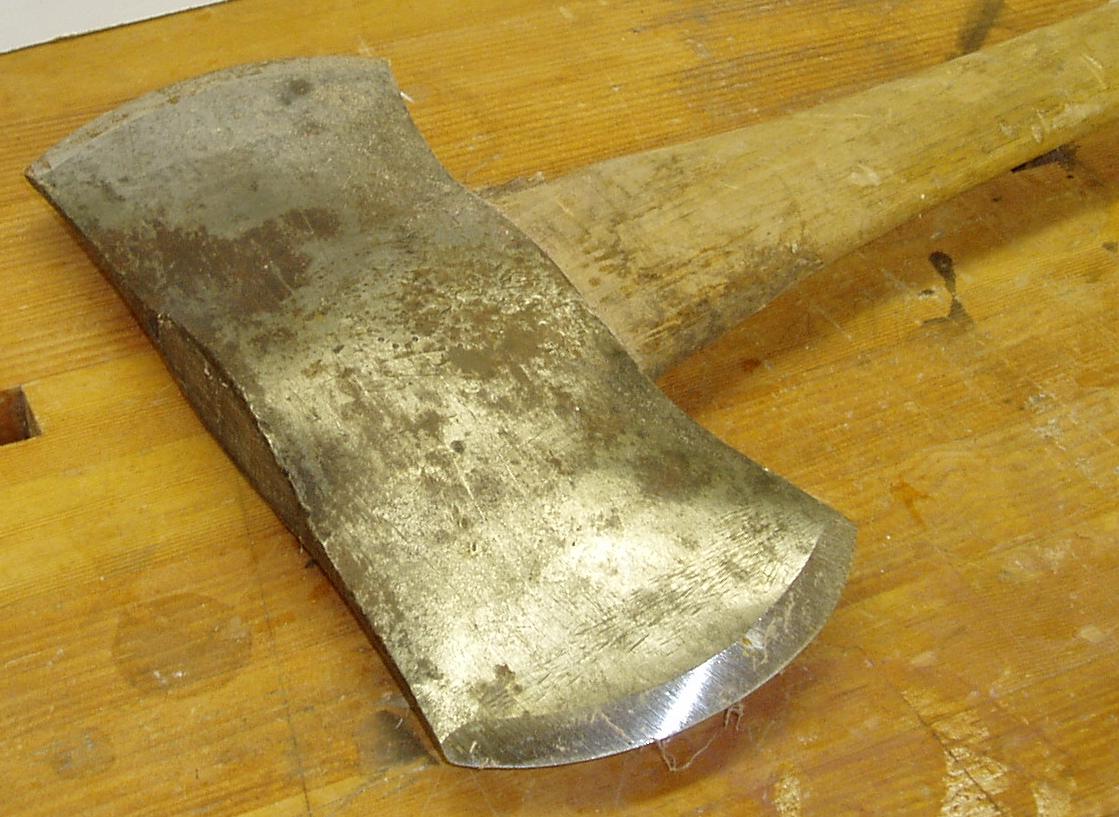
So the tree is on the ground, it's ready to be send to the mill right?  Wrong.  These trees were huge and moving them while they still had limbs was near impossible, so they were taken off by a group of men called the swampers.  They would go behind after the sawyers had cut the tree down and remove the limbs with a double bitted felling axe.

Now looking at their tool you can immediately see what danger they had to deal with.  Walking through the thick underbrush with a VERY sharp axe, cutting the limbs and branches off of giant trees; this surely led to missing toes and cut up legs!  Don't miss work though, the boss would have had you replaced in short time!
Not only did they have to remove the limbs from the trees but they were in charge of cutting a trail to the trees   for the sawyers and cutting the logs into 8-12 foot sections.  This made them more manageable for the men and horses to move.
After the logs are down and de-limbed they needed to be brought out to the road where the sleigh would come along to pick them up and bring them to the river.  This job was left up to the skidders.  These men were in charge of hooking a chain up to the log, attaching it to a harness on oxen in the early days and then horses in the later days, and leading the log out to the road.  Their tool was a large and heavy one called a cant hook.


The cant hook and peavy were very similar tools but the peavy has a point whereas the cant hook is dull at the end...


Being a part of the lumberjack community sounds fun on the outside but it was hard and dangerous work!  There was even more going on but we'll talk about that next time!


It's finally warm out and looking like it'll get warmer!  My lilies and iris are starting to poke through the soil looking for the warm sun.  I figure if they're hanging out in the sun we should all be too, so take it outside today!


The Minnesota Historical Society has great information and photos of logging in Minnesota.  Here's their link:
http://www.mnhs.org/places/sites/fhc/logging.html


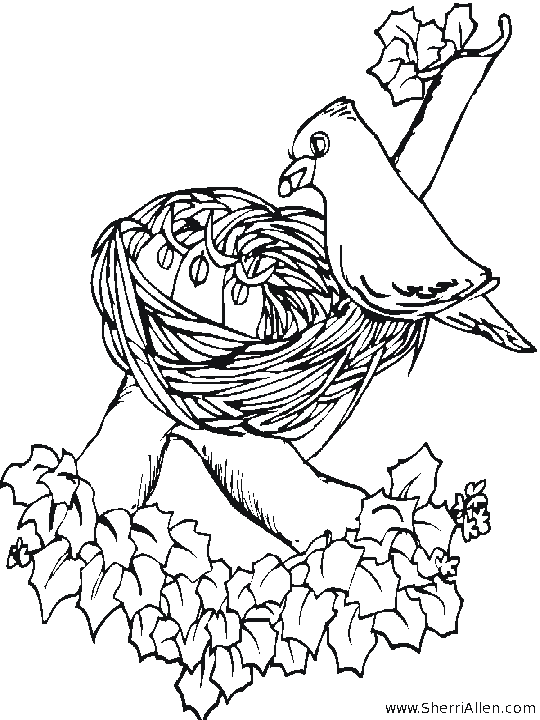
Here's some great spring coloring pages:
http://www.leehansen.com/coloring/Seasons/images/spring-poster-clr.gif
http://www.sherriallen.com/coloring/images/spring1.gif
http://www.myactivitymaker.com/ColoringBook/Spring.jpg


Crosscut saw photo:
http://www.fhwa.dot.gov/environment/fspubs/04232822/fig01.jpg
Axe photo:
http://upload.wikimedia.org/wikipedia/commons/c/cf/Double_bitted_felling_axe.jpg
Cant hook photo:
http://www.fhwa.dot.gov/environment/fspubs/05232810/fig112.gif
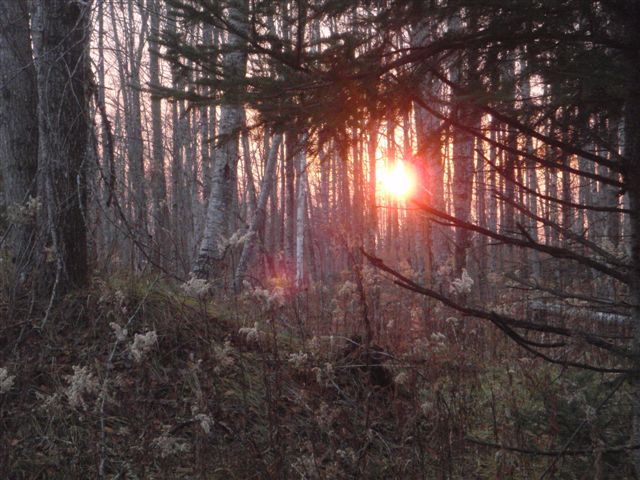
Spring photo:
http://images.paraorkut.com/img/pics/images/i/its_spring-12372.gif

Monday, March 21, 2011

They had to use what to cut down trees?!?!?

So in the last post I talked about why the loggers did their jobs in the winter and which trees they preferred but didn't discuss HOW they went about getting those giants down and to the river...
There were many different jobs to be had in the logging camp but it was essential that all of those jobs worked together for the larger goal. 
Around the turn of the century, like most careers at the time, a logging career started for most at a very young age.  Some of the workers were as young as 9-10 years old.  They started at the bottom as Bull Cooks.  These hard working kids had a tough job.  They were expected to get up before the rest of camp, along with the cook, and make the gigantic breakfasts the rest of camp needed to get through their day.  Now keep in mind that the rest of camp usually woke up around 4:00 - 4:30.  The Bull Cooks were in the kitchen with the cook and had to do the grunt work like peeling potatoes.  (think of how many potatoes a group of 30-40 loggers could eat in a day!!)


Then after breakfast was ready, the bull cooks would have the task of waking the rest of camp up.  They would have to yell "daylight in the swamp!!"  It was like the loggers version of an alarm clock.  Why don't we all see if we could be bull cooks by yelling "daylight in the swamp!" 
I'll wait...

Did you do it? 
Good!
So after these kids made breakfast, and woke up the rest of camp, they had to make sure all of the food was stocked on the table so the loggers could eat quickly and get out to work.  After breakfast was done, the Bull Cooks would clean the dishes and start making lunch.  This meal was a little more tricky because most of the time the loggers were far enough away from camp that they wouldn't come in for lunch which means the Bull Cooks would have to bring it out to them.  In the cold, and snow, without spilling the food.  And don't forget they were as young as 9 years old!
So after they brought lunch out to the loggers, they would have to come back in, clean the dishes and start dinner.  After dinner, they would clean the dishes, and get what little sleep they could before the next morning and they would start all over again!  So these youngsters were up before the loggers, all the while the loggers were awake, and AFTER the loggers had gone to bed!  Those are long days!
Oh and I forgot to mention that they only got paid around 25 cents a day. 

Wow!
Another entry level job in the logging camp was the position of Road Monkey.  While these weren't 9-10 year olds, they were still young; around 14 most of the time.  Their job was hard, and dangerous.  They were to go out during the night and make sure the roads were iced up well enough for the sleigh to slide on top of them.  Doesn't sound that tough or dangerous right? 
Well keep in mind that it was often -40 or colder at night,  
They had a giant wooden tank of water that they would have to let run into the grooves of the road, staying dry was likely not an option,
There were predators out in the woods at night, surely the horses could have been spooked, and
The majority of logs in this area were sent down a river to the mill, and we all know where there's a large river there's bound to be a hill with snow and ice!
All of this, and they were 14!


There were many more jobs in the logging camp but they'll have to wait until next time!
I know it's muddy but it's finally nice outside so remember to Take It Outside Today!


Great account of logging life here:
http://www.cameraontheroad.com/family/my-first-job-working-logging-camps-in-wisconsin/


Log Cabin Coloring Page:  http://www.google.com/imgres?imgurl=http://coloring.thecolor.com/color/images/Lincolns-Log-Cabin.gif&imgrefurl=http://www.thecolor.com/Category/Coloring/President%27s%2520Day.aspx&usg=__oxlFoyJEr9j0XN1bjrZUpR98KQk=&h=565&w=552&sz=9&hl=en&start=32&zoom=1&tbnid=IV8qkscDI7judM:&tbnh=125&tbnw=122&ei=f8CHTY6_GIiErQHJpuSzBg&prev=/images%3Fq%3DLogging%2Bcoloring%2Bpage%26um%3D1%26hl%3Den%26rlz%3D1C1PRFA_enUS422%26biw%3D1280%26bih%3D709%26tbs%3Disch:10%2C1000&um=1&itbs=1&iact=hc&vpx=566&vpy=131&dur=330&hovh=141&hovw=138&tx=49&ty=117&oei=bsCHTbeXK8mHrgHXivm0Bg&page=2&ndsp=34&ved=1t:429,r:29,s:32&biw=1280&bih=709
Silly Logging Coloring Page: http://www.google.com/imgres?imgurl=http://www.supercoloring.com/wp-content/main/2010_04/sawing-log-coloring-page.jpg&imgrefurl=http://www.supercoloring.com/pages/sawing-log/&usg=__QaEjsjz6OvX9EEPxHxOJ5MRKPuc=&h=350&w=458&sz=51&hl=en&start=0&zoom=1&tbnid=nCydJHUDxeCw6M:&tbnh=132&tbnw=173&ei=bsCHTbeXK8mHrgHXivm0Bg&prev=/images%3Fq%3DLogging%2Bcoloring%2Bpage%26um%3D1%26hl%3Den%26rlz%3D1C1PRFA_enUS422%26biw%3D1280%26bih%3D709%26tbs%3Disch:1&um=1&itbs=1&iact=hc&vpx=394&vpy=91&dur=2370&hovh=196&hovw=257&tx=109&ty=117&oei=bsCHTbeXK8mHrgHXivm0Bg&page=1&ndsp=32&ved=1t:429,r:2,s:0


Swamp Photo: http://joeroads.com/wp-content/uploads/2010/11/daylight-in-the-swamp.jpg
Quarter photo: http://www.brunswick.k12.me.us/lon/lonlinks/grade1/money/images/us-quarter.gif
Camp photo: http://www.d.umn.edu/cla/faculty/troufs/Buffalo/images/pf010264.jpg


Wednesday, March 2, 2011

Sawing Logs!

Sorry for the lapse in postings!  We just spent a week in the Caribbean soaking up the sun!!  And might I add, it was quite hard to return to the cold and snow that Wisconsin brings this time of year! 


So the winter time often leads people to spend more time indoors than out.  Frigid temperatures and deep snow could have something to do with it I think.  What I can't imagine however, is men leaving their families for months at a time to work in these conditions! BBRRR!!
That is exactly what men in the 1880's and through the turn of the century did along the St Croix River Valley.  Many men would leave their families and flock to the river valley for the cold winter months to work for a logging company.  Their job may seem like an easy one but in fact there were a lot of steps and A LOT of danger involved in their jobs.
  So everyone close your eyes and picture a lumberjack...do you have a picture? 
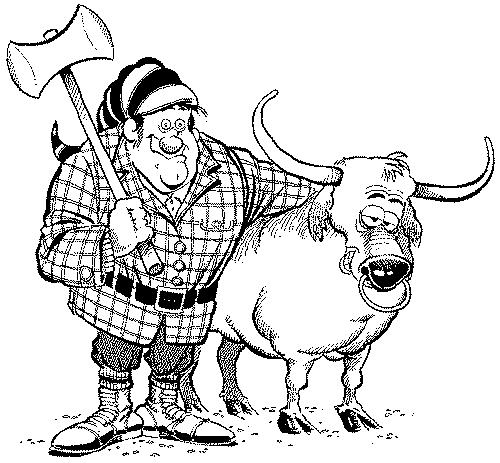
                                             Does it look like this man?
Massive, burly, and wielding an axe.  Paul Bunyan.  That's what most people think of when they think of a lumberjack, and to be honest, that's not too far from what I've seen in photos.  Maybe they weren't all giants that had a blue ox named Babe as a pet but they were burly, many of them bearded, and most of all, hard workers. 
Why in the world would loggers choose the harshest time of year to do their jobs?  Well there's a couple reasons. 
1.  Even though it was MUCH colder then in the winter than it is now, can you imagine logging in the summer time with the heat, humidity, and all those bugs?  No way!  Even though it was so cold out (many mornings plunging below -40) these men still worked up a sweat doing their jobs!
2. With winter, like we've talked about, comes snow.  Just like the temps were colder then, there was much more snow on average than there is now.  Moving and transporting the logs in the winter on top of the snow and ice was much easier than in the summer on top of the grasses and other plants. 


The next natural question is, "Did the take all of the trees or just some?"  The majority of the trees were taken but the loggers came to this area in particular for the large quantities of white pine.    Why white pine?  Well they took these for two reasons.  First they were giants in those days, standing well over 100 feet tall. 
Secondly, these trees floated well which was essential since they would be sent down river to the mills to be cut to size.
The White Pine was not the only tree taken, many places were completely stripped of all trees which later was inhabited by farmers who would remove the stumps and farm the ground. 


So these men would work hard throughout the winter logging this area and cutting down giant trees in the coldest of weather in the most dangerous of conditions. 
But this begs the question, how?
That's what we'll talk about next time!
In the mean time, remember to Take It Outside!


Paul Bunyan Photo: http://www.kingoftheroadmusic.com/images/paulbunyan.jpg
Ice Photo:  http://media02.hongkiat.com/christmas_wallpapers_01/ice-firs-wallpapers_7717_1280x800.jpg
Photo of River: http://farm1.static.flickr.com/23/91938014_87f2bfc146.jpg?v=0
Sun Photo: http://www.worthingtonpools.com/files/6312/6150/3450/yellow-sun.gif

Friday, February 11, 2011

We're Havin A Heat Wave!!


         So this weekend is set to be warm!!  FINALLY a break from the sub zero arctic temps!  In continuation of the winter time critter watch I thought we could focus on some on the animals that we may not think about because we don't see them regularly in the winter!
         Winter is a great time to talk about camoflage.  If you're a small animal that is preyed on, it is definately to your advantage to blend in with the white of the snow, where there is some!
         A fantastic example of an animal that changes its appearance every six months are the three types of weasels we have in our area. 
Wisconsin DNR photo
We have three species of weasel in our area: Least Weasel, Short Tailed Weasel and Long Tailed Weasel.          
     All of these little creatures are pretty rare to see when you're outside exploring for a number of reasons.  First of all, they're pretty tiny.  The largest of them, the Long Tailed Weasel, is a maximum of 16 inches and the smallest, the Least Weasel, is a maximum of 8-9 inches.  No wonder we don't see them, something this small is pretty easy to hide!  If you add that with the fact that every fall they lose their brown summer coat and don a pretty white winter coat, they're even harder to see!  I've lived in this area my whole life (26 years) and have yet to see one of these little critters in the winter. 
Long Tailed Weasel
              
         If you think you might see one of these animals there's a few things to look for.  First and foremost, the size.  Like I said before the largest of these critters are about 16 inches, next thing to look for would be the color of course, white in the winter; and the last thing and possibly the most tell tale sign is the black tip in the end of their tail!

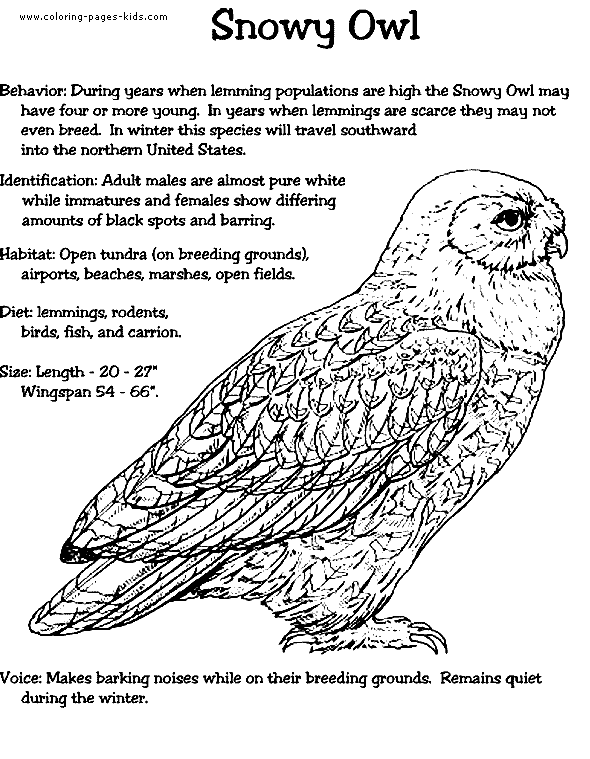
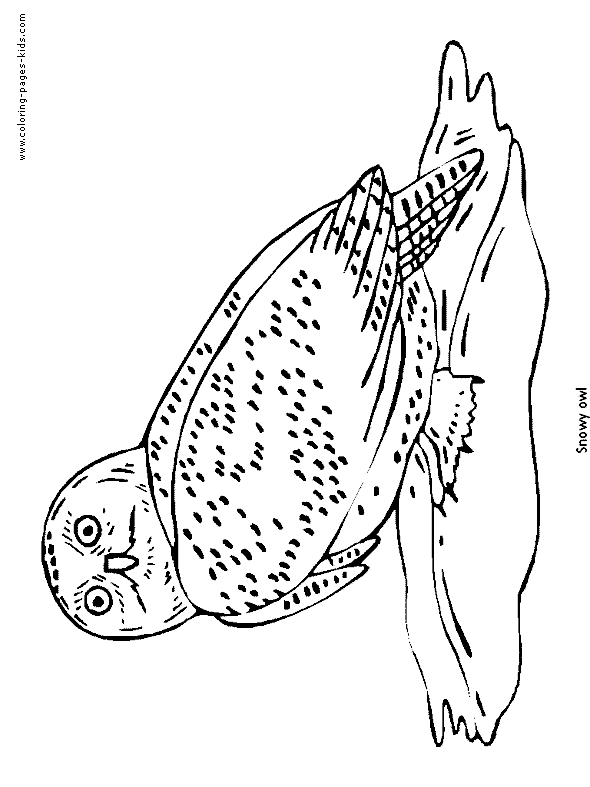
Another animal that blends in well in the winter snow is the aptly named snowy owl.  These large beautiful birds a truly a sight to behold. 

Snowy Owl
        While the snowy owl is a somewhat rare sight in this area, if you're lucky you'll get to see one.  They aren't usually seen perching in places that seem natural where they'd be hidden, like in trees.  When they are seen, they're on top of hay bales, sitting in a field or even just hanging out on the ice.  You can see from the photo above that they easily blend in with the snowy areas in which they live.  They don't breed here so when they are seen it's only for a brief amount of time and then they'll move back north for the breeding season.
       These haunting critters are also carnivores, meaning they like to eat meat.  Their favorite meals include weasels, rodents, rabbits, and even waterfowl.  They aren't a small bird either, which may help with their food habits.  Their height ranges anywhere from 21-28 inches and can weigh up to 6.5 pounds. 

These are just a couple of the animals that change their appearance for the winter season.  Go outside today and see if you can find any other animals that have changed appearance for the winter!

Here's some more coloring pages too!!


Here's a great way to get involved with an ongoing scientific study!


 Sources:
http://icwdm.org/handbook/carnivor/ca_c119.pdf
Long tailed weasel photo:  http://www.saskschools.ca/~gregory/animals/images/weasel1.jpg
Snowy Owl Photo:  https://bcsengage.wikispaces.com/file/view/Snowy_Owl_Pic.jpg/52102825/Snowy_Owl_Pic.jpg
 http://www.allaboutbirds.org/guide/Snowy_Owl/lifehistory

Palm Tree Photo
http://media-cdn.tripadvisor.com/media/photo-s/00/19/5b/f6/palm-tree-on-beach.jpg

Wednesday, February 2, 2011

More Snow?!?!?

So, it's snowing...again!  Where I live in Northern Wisconsin, people get pretty sick of snow and cold by this time of year.  That's why I have chosen winter as my first topic.  I know that technically it's not an ecosystem, but in a way it is!  Both plants and animals behave and live differently in the winter than they do at any other time of the year, and where there is snow, it definitely creates a habitat of it's own. 
Even though it's winter, it's still a great time to go outside and explore the world! 
Go outside, take a hike where there's some wildlife, trees, or any evidence of winter and ask how these species may have had to prepare for winter. 
I often tell students that animals aren't like us, they can't put on a hat, mittens, snow pants and coats.  They have to rely on a variety of other adaptations to stay warm in the winter.  Some get thick warm coats, some rely on fat resources, some decide to take a winter long snooze, and some just leave!
Over the next couple of days I'll talk about a variety of animals along with plants and how they prepare for the long cold months that winter often brings.

Beavers are a perfect example of a critter that makes sure it can make it through the winter effectively. 
NPS Photo
These cute critters are the largest rodent in North America and make their homes across much of the continent.  They are strict vegetarians that love to nibble on aspen and birch trees.  But wait!  They live in the water, right?  And in the winter, at least around here, the water freezes!  There are a few things that our local beavers do to survive these frigid months.  All beavers live in lodges of some sort.  Either they build them like little domes in the water from sticks and mud, or, in a large river setting, they will make what looks like and extension of the shore out of the same materials.  Either way, their homes are giant piles of sticks and mud.  So in a setting where the water freezes over completely they spend much of the fall storing sticks and branches underwater in a cache that can add up to around 100 pounds.  Many lakes and rivers, although mostly frozen, contain openings periodically which are usually around inlets or outlets and beaver will often take advantage of these and use them to get food if needed.    Beaver will also store fat on their bodies to help them make it through the winter.
Living in the water in the winter would logically cause some issues with warmth.  Beaver have a number of adaptations to help them with this issue as well.  First and foremost they have a very thick coat that helps them to stay warm.  This is a coat common among furbearing species.  It contains two layers, the long layer is thick  but it's the shorter under layer that keeps them warm.  It is very very thick and very soft.  It helps to act as insulation for the animal.  It's not only built in winter clothes but it helps to keep the frigid water away from their skin.  This under coat is also the cause of their near extinction.  The undercoat was made into felt, and then into hats and vests which were popular attire in the 1800's.
One last adaptation that beavers have is one that is produced by their oil gland and is called castoreum and they rub this oil all over their bodies and it's like a waterproofing coat to keep the water away from their skin just like the thick underfur!
 
 There are so many critters that are adapted to living and surviving winter months!  In the coming days I'll share some of these animals and some activities to help think of winter in a different way!

In the mean time, here's a couple links to great beaver coloring pages!
http://www.bradfordonizedfederalcu.org/Portals/3/beaver2.jpg
http://www.kids-n-fun.com/kleurplaten/ijstijd/thumbs/ijstijd_09.gif
http://www.edupics.com/coloring-page-beaver-nest-i9448.html  (great picture of a lodge to color!)